
The Battle of Jutland Monument was erected in Cobh, Co Cork, at the Bible Garden of the Benedictine Nuns on June 2nd, 2018. This was 102 years after the greatest naval battle of the modern era was fought in European waters. The monument commemorates the 20 Irishmen from Cobh who gave their lives during the battle, as well as the Cobh locals who fell during the Great War.
I was commissioned by the Jutland Memorial Society to sculpt a monument honouring those fallen heroes.
What the Monument Commemorates
For several years, the community of Cobh and the descendants of the fallen had felt there was a lack of formal acknowledgement of Cobh’s contribution to what was the Great War’s largest naval battle and a strategically decisive victory for the Royal Navy against the German Empire.
One of the key motivating figures behind the monument was Eithne Wright, the great-niece of Shipwright William McGrath, one of the fallen Cobh men who perished aboard the HMS Queen Mary. She told me that there was nothing in Cobh about her great-uncle, and that she simply wanted something done to acknowledge him and the many other fallen men. That stayed with me.
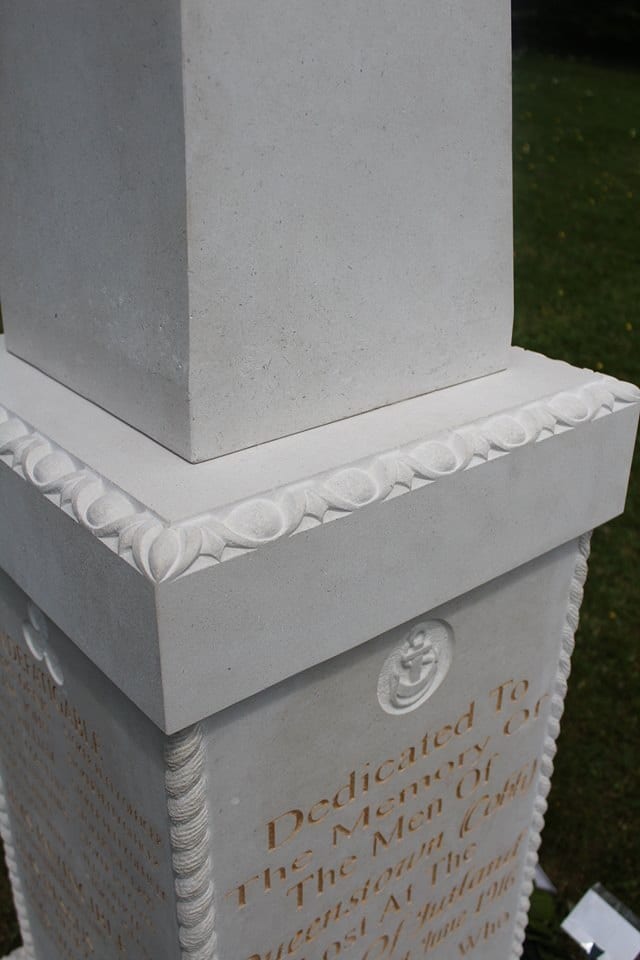
The monument reads, at its centre:
Dedicated To The Memory Of The Men Of Queenstown (Cobh) Lost At The Battle Of Jutland 31st May – 1st June 1916 And All Those Who Served In World War One
Lest We Forget

Commission and Community Involvement
The monument was commissioned directly to me and was not tendered. Ms Eithne Wright, Chairwoman of the Jutland Memorial Society, had been campaigning and fundraising for a memorial for several years, eventually raising around €7,000 to make it happen. She came to me directly for this particular monument, and I was glad she did.
Design
The obelisk stands at 8ft and the design was specifically chosen for its maritime associations. Obelisks date back thousands of years to ancient Egypt, but in this context the intent was to connect the naval and maritime history with the event being commemorated.
Portland stone, sourced directly from Portland, England, was deliberately chosen as the material to give the monument a connection to England. Although the monument commemorates Irish voluntary conscripts from Cobh, the battle itself was pivotal for the Royal Navy, and the majority of the 6,784 fallen were British, alongside conscripts from the Canadian and Australian colonies and around 350 Irishmen.
I design everything at the start of a project, so the commissioner knows what they’re getting by the end of it. There are no hidden surprises. Changes can be requested throughout to refine the finished piece, and that’s how I prefer to work.
Sculpting and Installation
Portland stone is a relatively straightforward material to work with. The obelisk form itself was quite manageable. When you’re dealing with a figure, it’s a completely different animal, but with a piece like this the most time-consuming work was getting the names in and the fine fiddly details, such as the moulding around the corners and the lettering at the base. In total, the monument took around 4 to 5 weeks from start to installation.
The Unveiling
The monument was unveiled publicly on a sunny June 2nd, 2018, at the Bible Garden of the Benedictine Nuns in Cobh. I was at the unveiling, as were naval and military representatives, descendants of the fallen, and members of the community.
It was a very moving day, and I was glad to be a part of it.
Acknowledgements
While there are seven other Jutland Memorials located across Britain and Ireland, I hope this one stands as a worthy tribute to the Cobh men who fell on that day. My sincere thanks to the Jutland Memorial Society, all event organisers and the committee, and to the Naval Service and Army for their presence in honouring the fallen.
For memorial or public commissions, please don’t hesitate to get in touch.
